Monday, January 31, 2011
The Joys of a Structural Foodie


Tuesday, August 17, 2010
New Project! Leesburg Child Care Facilities
We are pleased to announce that Sierra Engineering Group’s
This project involves the conversion of a 1920’s era structure currently used as a document storage facility into a
This is a 1-story building with timber truss roof framing and clay tile walls. The creative team will be adding a screened-in play area, new window and door openings as well as a new entry porch. In accordance with the design character of the existing building and out of respect for the structure’s history, framing for the new areas shall consist of pre-fabricated wood trusses and masonry columns. Since the original structure is unreinforced masonry, portions of the existing building will also have to be strengthened in order to comply with current codes.
Here's a sneak peek at the site plan, we'll post more updates throughout the design/building process.

Posted By: Sara
Friday, July 23, 2010
SEG is now licensed in New York!

Wednesday, April 14, 2010
Art and Structural Engineering

Disney Concert Hall, Los Angeles, CA
Architect: Frank Gehry, FAIA
Structural: John A. Martin & Associates Inc.
Photo: by Carol M. Highsmith
Art is a form of self expression. Every painting, photograph, sculpture, poem, prose, song, dance, all forms of art, exposes something about the artist. The medium is simply the vehicle by which the artist renders his or her unique perspective. Even a painting depicting a particular moment in history offers in some way, the biased view of the artist, interjecting his own opinion in the piece, making it his and only his. However, most people tend not to think about structural engineering in the same way.
They consider structural engineering as having a set of rules to follow, allowing little room for self expression. Certainly our profession is based on scientific facts and the laws of physics, but those are merely our tools, our brushes, our scalpels, our musical instruments with which we are able to create our own vision.
Structural engineers may be labeled as conservative or liberal. As opposed to the normal political meanings of the terms, conservative in this case is associated with overly cautious design, an entirely subjective view normally related to the cost of the structure. Likewise when an engineer is labeled as too liberal, it is associated with carelessness, again a subjective observation usually associated to a previous experience on the part of the person passing judgment. Rarely is the engineer afforded the same latitude that an artist is granted when expressing his views through his art.
Structural engineering is our art, and simply because we need to work within certain parameters does not imply that our work lacks our unique perception when arriving at a given solution. Like all other art forms our answers are open to interpretation and diverging opinions as they our undeniably our own. Just like the Mona Lisa is not just a painting, just like the Temple of Sagrada Familia is not just a church or the Venus de Milo just a sculpture, neither is the Golden Gate Bridge just a bridge or the Eiffel Tower just a tower.
Our work is often misunderstood or dismissed as the obscure inner workings of an architectural vision, thus negating its contribution to the realization of that vision. But in truth it is no different than an Architect’s design, often described as creative and unique. The structural system used in the Disney Theater in Los Angeles is no less singular than Frank Gehry’s signature design. The lack of visibility of our work should not serve as an excuse to deny its own artistic contribution.
Creativity brings added value, especially in structural engineering. Our thinking is not bound by the rules but rather enabled by them. An artist is not limited by his medium but rather spurred to express himself through it. Those set of rules, the laws of physics, are our medium and using that medium we are able to express ourselves in unique ways. We don’t view these rules as limits but rather tools with which we can create solutions. They are the tools with which we are able to practice the art of structural engineering.
Posted by Jesus Sierra, S.E., President
Thursday, April 1, 2010
Sierra Engineering Group welcomes a future engineer!


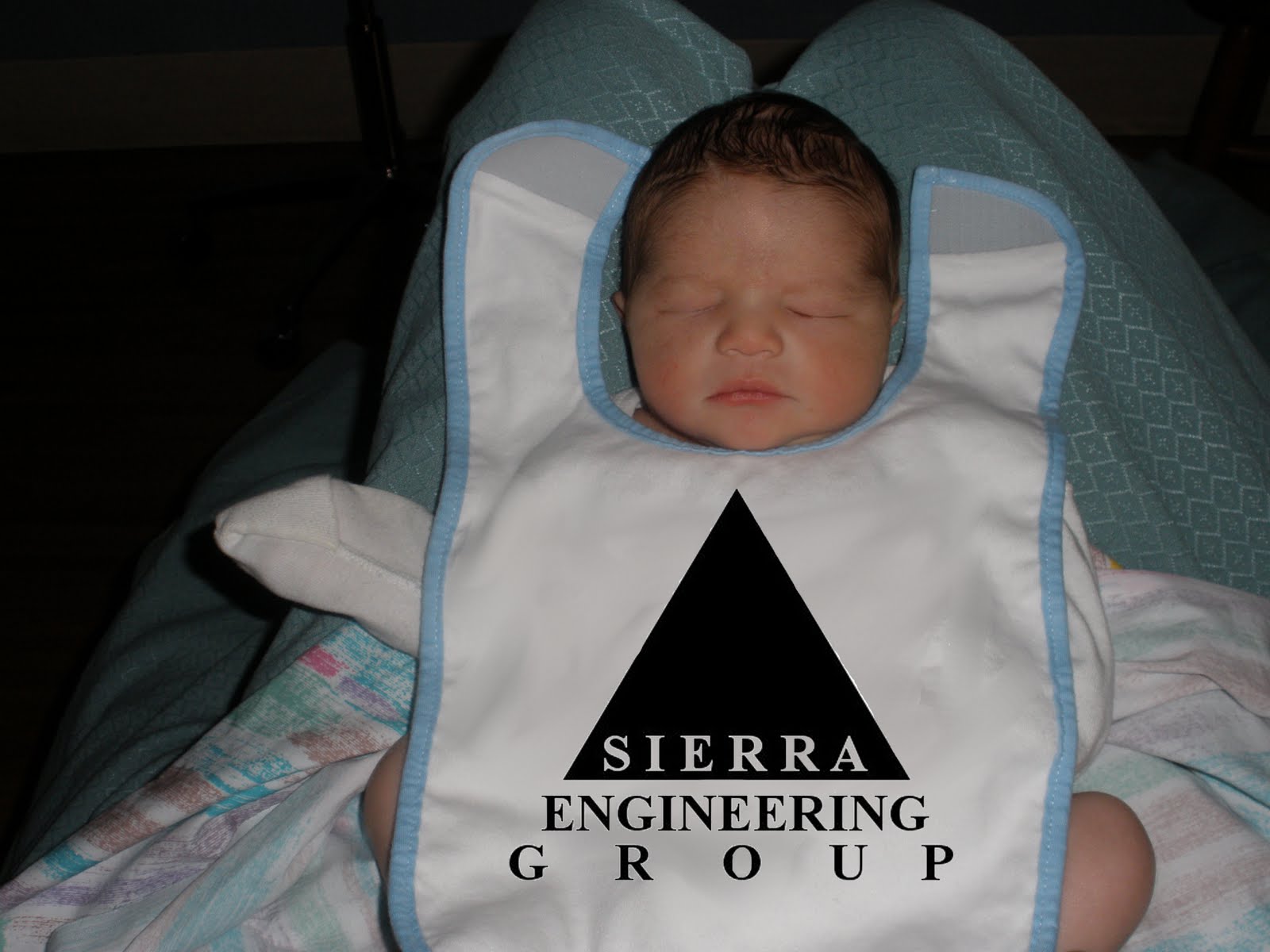
Posted by Sara Dunaway
Wednesday, March 24, 2010
101 Forest Nears Completion
The structural system consists of a combination concentric braced frames and CMU shear walls in one direction and Special Moment Resisting Steel Frames in the other direction. The L-shaped building also required a seismic joint to separate the more flexible moment frame side of the structure from the more rigid CMU shear wall side. The Hayes Group design expresses the structural elements throughout the building, even exposing the exterior pipe columns along the Alma street elevation. As structural engineers we admit our bias to such systems as opposed to others where our work is hidden behind finishes. In a case like this our work not only has to address the structural requirements but the solutions also have to be particularly sensitive to their visible aesthetic impact. This would not have been successful were it not for a true collaboration between architect and structural engineer.
An intriguing blend of finish materials along with the large glass expanses create a uniquely distinct building with spacious, light interiors which should appeal to a wide range of potential tenants. We are very proud to have been a part of this process. The building is scheduled for completion in the next couple of months.
Posted by Jesus Sierra, S.E.


Sunday, March 14, 2010
Haiti: A Call To Arms for the Engineering Community
In a place like Haiti, that endured a devastating earthquake that killed in the order of 200,000 people, we need to understand the reasons behind such widespread structural collapse. Haiti is one of, if not the, poorest country in the world. Infrastructure is non-existent. It has a system of government so corrupt that it lacks the ability or the will to enforce any sort of building standards. The process of instituting and enforcing building policies takes money, which Haiti lacks. Consequently, the approach needs to be more deliberate, more realistic and able to account for the true life conditions for the majority of the population in Haiti itself.
It would be easy to, for example, write up code requirements for enforcing material qualities; cement mixes to be tested and approved or for reinforcing steel to be installed in block walls and grouted properly or for roofs to be properly anchored, for foundations to be to be placed without debris in the excavations and for them to be properly dimensioned. But too many of the dwellings there are built without guidance, or proper supervision. They are built outside any potential enforceable safeguards.
Suggested solutions have included providing container housing or prefabricated homes. Both of those are ways to create business for the companies providing them under the guises of goodwill. Although it may assuage the immediate housing problem, these solutions ignore the long-term sustainability of Haitian society. The companies that produce them will make money, Haitians get temporary housing, but the Band-Aid does not stop the root cause, it merely masks it.
We need to approach this with the knowledge that the realities on the ground in Haiti are not going to change overnight. Government will not avoid blatant corruption. People will not place trust in a system that has failed them time and again. People trust only themselves and will do what they must to survive on their own. They will build using the limited resources that they have available. This is where building policy and the responsibility of the engineers must begin. This is where our volunteer efforts must start.
Think about all those contests and class assignments we had in engineering school: building bridges out of toothpicks, canoes out of concrete, dropping an egg from a rooftop and coming up with a way to keep it from breaking using limited materials. We need to think like Robinson Crusoe when we contemplate rebuilding in Haiti and imagine utilizing only those materials accessible to the poor majority, with rudimentary tools and limited craftsmanship. We must dedicate ourselves to coming up with ideas that we can offer people in Haiti, about how they can construct safer dwellings- simply and economically. With a bit of creative thinking and will, we can, as a community, provide them the proper guidance.
One possible solution is to distribute easy-to-understand instructions that the average Haitian citizen can follow to create simple dwellings. The makeshift structures destroyed in the earthquake may be re-built using similar materials and construction techniques, but with better instructions on what to avoid and what to implement. This should not preclude efforts to build a governmental infrastructure system that can institute and enforce more stringent building regulations, but it’s a way to begin to instruct the people on basic seismic and wind construction practices. It is a way to shine a light on the causes of this massive destruction and to arm all Haitians with knowledge. It is a way to build trust in the engineering community and a way to have the general population understand that our intent is neither politically nor business oriented, but only to help insure public safety even to those people who may be perceived as undeserving.
Every life saved brings with it the possibility of hope and a better future. The best way to proceed is to initiate and participate in a true assessment of the building materials used in these communities. To evaluate the resources that are readily available and begin to work out potential solutions making use of those limited resources. We ought to not be driven by potential personal gain, but for the betterment of global society at large. As structural engineers, ensuring public safety is after all, our unwritten oath.
Posted by: Jesus Sierra, S.E.


